The Born to License Podcast: 2025's best bits
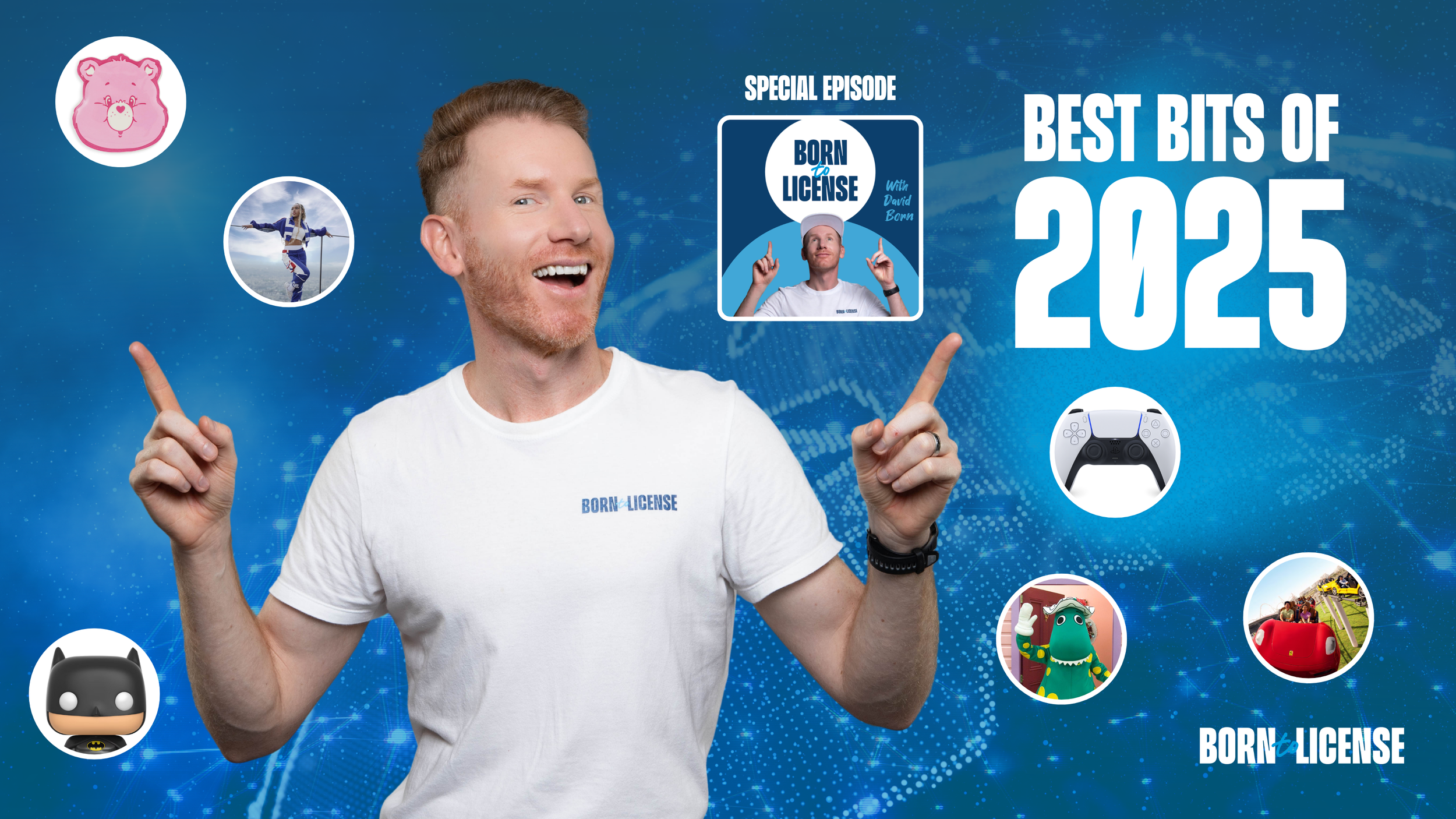
As the holidays wind down and that familiar restlessness sets in, I find myself doing what I always do this time of year - reflecting on everything we've learned. And what a year it's been!
Season two of the Born to License podcast brought conversations with some of the sharpest minds in our industry. From Funko managing over 1,000 licenses to the digital revolution reshaping everything we thought we knew about IP, these discussions weren't just informative - they were revelatory.
I've pulled together the biggest takeaways from this year's conversations. Whether you're deep in the trenches of licensing or just curious about where this industry is heading, these insights will give you plenty to think about as we head into 2026.
When Everyone Wants to Work With You: The Art of Saying No
Lucy Salisbury from Funko faces a problem most of us would love to have: managing over 1,000 active licenses with everyone knocking on the door wanting more.
Her approach? A blend of art and science that every licensor should study.
"We look at fan demand, content pipeline, retailer interest. We're constantly getting suggestions from our retail teams, from our sales teams on licenses they would like to see and cultural heat moments picked up from social media," Lucy explained.
But here's what struck me most: Funko doesn't just listen to what licensors promise. They're looking at Google Trends, TikTok data, Amazon searches. They're letting the fans tell them what works, not just betting on what studios claim will be the next big thing.
And when it comes to the Barbie or Wicked-level phenomena? They stay measured.
"We try to be quite measured in our risk. We'll happily back a really strong potential product opportunity. But when it comes to product ordering that's very much based on retail interest and demand. We don't want to be in a situation where we make too much product."
That discipline - backing opportunities while building in scarcity - is what separates the category leaders from everyone else.
Watch the full chat with Funko’s Lucy Salisbury below or find the episode on your preferred podcast platform.
The Three-Second Rule: Why Promotions Matter More Than You Think
Julia Komodo from Hasbro opened my eyes to something I hadn't fully appreciated: the power of promotions in licensing.
Think about McDonald's Monopoly. It's been running successfully for three decades across more than 20 countries. That's not an accident—that's licensing magic.
"If it's an iconic IP that immediately cuts through the noise," Julia told me. She referenced an Amy Winehouse quote about how if you can draw someone's look, it's truly iconic. The same applies to characters like Peppa Pig or Mr. Monopoly.
The promotions space moves at lightning speed compared to traditional product licensing. You've got three seconds to capture someone's attention in a supermarket aisle. But when you nail it with the right IP and the right moment, you're not just making a sale—you're creating an emotional connection that drives real uplift.
Watch the full chat with Hasbro’s Julia Kamoda below or find the episode on your preferred podcast platform.
Digital Isn't a Category Anymore—It's the Future
Simon Kay has been focused on games and gaming for 30 years, back when people thought he was crazy. Now? He's watching his predictions come true in real-time.
His message about where we're headed with UGC, Web3, and digital assets was both exciting and urgent: "Every IP owner needs to have a strategy with regards to what's the right amount of money I should get from someone reselling an asset in a web3 space with my brand on."
But the most important thing Simon said? "Don't wait for it anymore. You've got no time. If you're not proactive now with this space, you'll just miss it all."
This isn't like the old console lifecycles where you had 7-10 years to plan. New opportunities are emerging weekly. If you're not experimenting and learning now, you're already behind.
Watch the full chat with AT Media’s Simon Kay below or find the episode on your preferred podcast platform.
The Unsung Heroes: Product Development Deserves More Credit
Jenna Chalkley, our Head of Product Development at Born to License, and I talked about something that's been bothering me for years: product development professionals don't get nearly enough recognition in this industry.
"I think it's more of a sales driven industry, or it definitely has been previously," Jenna said. "Years ago, it would be a brand and a character slapped onto a product. But people are being a lot more creative now."
She's right. The role has evolved from simple application to genuine creative problem-solving. Great licensed products require keen eyes for detail, understanding of manufacturing, knowledge of what makes products authentic to the IP.
Signing the licensing deal isn't the finish line—it's just the start. The real work happens in product development, and the people doing that work deserve far more celebration than they get.
Watch the full chat with Born to License’s Jenna Chalkley below or find the episode on your preferred podcast platform.
Managing the Hottest Brand on Earth
Michelle Ahern lived through something most licensing professionals can only imagine: managing licensing for the Wiggles during their absolute peak.
Thousands of requests. Everyone wanting a piece of the action. How do you even manage that flood?
"We had incredible licensing agents," Michelle said. "But the main thing was that because they were homegrown, family based, a group of friends creating a business Born out of entertaining children, the number one rule on everything was what's in it for the kids?"
That values-first approach meant having a nutritionist on the team. It meant being one of the only successful preschool properties globally to never endorse confectionery. It meant every decision filtered through whether it was actually beneficial for children.
The lesson? When you have a truly hot property, strategic thinking matters more than saying yes to everyone. Your brand values aren't just marketing—they're your decision-making framework.
Watch the full chat with Born to License’s Michelle Ahern below or find the episode on your preferred podcast platform.
Nostalgia Isn't Enough
Charlotte Payne from Cloudco Entertainment manages Care Bears, a brand that's been beloved for 45 years. But she's crystal clear about something crucial: nostalgia alone won't keep you relevant.
"Care Bears in its nature is a plush toy and bear that people love to cuddle and it's colorful. But I think the interesting thing with nostalgia brands is that they can gravitate in a different way to new audiences and kind of serve a purpose."
Care Bears connects with millennials who grew up with the brand. But they've also found traction with Gen Z teens and tweens through fresh content on TikTok. They're speaking to multiple generations, not just banking on memories.
That's the art form: respecting what made a brand special in the first place while earning relevance with each new generation.
Watch the full chat with Cloudco’s Charlotte Payne below or find the episode on your preferred podcast platform.
Read Your Contract. No, Really Read It.
David Schnider from Nolan Heimann has reviewed thousands of licensing contracts, and he shared some red flags that inexperienced licensees often miss.
The biggest one? The definition of net sales.
"People come to me and say, yeah, I got a 10% royalty. I said, great, 10% of what? It could be your profits, your gross. I have had new licensees come to me thinking they're paying 10% of their profits, and they're not. They're paying 10% of their gross."
Another trap: transfer fees. If you sell your company or change ownership, many modern licensing agreements give the licensor a cut of that transaction. "It's now fairly common, but it wasn't 10 years ago."
These aren't necessarily traps—they're just contract provisions that can cause problems if you're not paying attention. Read the fine print. Understand specifically what you're paying on. Get legal counsel who knows licensing.
Watch the full chat with Nolan Heimann’s David Schnider below or find the episode on your preferred podcast platform.
Where the White Space Actually Is
Sharon Weisman thinks about licensing not just as it is today, but as it will be in five or ten years. Her perspective on emerging trends was fascinating.
"Our hot pockets right now that everyone needs to look into is wellness and education. The pandemic did a number on us, and we all want to be healthier, and we all want to live better."
She's watching men's wellness and grooming (expected to hit $115 billion by 2028), branded supplements, fitness apps, sleep technology, mental health tools. Athletes are becoming the new personas consumers trust and want to emulate.
And here's the kicker: personalization is fracturing everything. "Once upon a time, it was David taking aspirin. Everything will be okay. Here's a blockbuster drug that will solve all our problems. And now we want health products that are customized."
The licensing opportunities in personalized wellness products are massive and largely untapped.
Watch the full chat with Sharon Weisman below or find the episode on your preferred podcast platform.
Location-Based Entertainment Is Evolving
Annabel Rochfort shared insights from her work with global consumer brands on location-based entertainment, and one category stood out: competitive socializing.
"Ferrari launching the esports tournament during COVID was the most organic brand extension for the business to continue to engage with their fans. I think competitive socializing is a big one."
But she also highlighted something practical: destination resorts that bundle everything together. When you look at what Yas Island does in Abu Dhabi—where your hotel stay includes all theme park tickets—you see the future.
"For a family to travel, book a hotel, book a flight and book to go to Universal, book to go to Disney World, it's expensive. So if you look at the model where you stay in the hotels and you get all theme park tickets included within your stay, I think that will be a big trend."
The lesson: make it easy for families to say yes by bundling the experience.
Watch the full chat with Annabel Rochfort below or find the episode on your preferred podcast platform.
Authenticity Isn't Optional Anymore
Jasmine and Vincent from Fira x Wear represent something we're seeing more of: entrepreneurs building brands that bridge the gap between licensing and original IP.
When I asked how important it was that they were genuine fans of My Hero Academia—the first property they licensed—Vincent was unequivocal: "From a passion perspective, I think it's of the utmost importance."
"This company is our baby. We want to do everything well and of high quality, but we also want it to align with our passion because otherwise we can just do our nine to five jobs."
That authenticity shows in every product they create. And here's the beautiful part: even people who aren't My Hero Academia fans are buying their products because the quality and design stand on their own.
Watch the full chat with Fira x Wear’s Jasmine and Vincent below or find the episode on your preferred podcast platform.
The Creator Economy Is Disrupting Everything
Caleb, known as the Collab King, represents the future of licensing in many ways. He's built a business as a content creator around collaborations with major brands.
His biggest piece of advice for brands? "Don't be afraid of the secondary market."
"If you release something that's $10 and you look on eBay that it's $100, congratulations, you have created insane hype around your own product. If you adjust to that and say, okay, that hundred dollars should be our hundred dollars, we need to 20x the amount of product next time and make sure that those eBay prices are lower."
The mistake brands make? Overproduction out of fear or greed. "That's what killed Beanie Babies. They overprinted one day and they essentially just killed their brand."
Caleb's story shows that licensing is being disrupted by creators who have direct access to audiences and can negotiate from positions of strength. Brands that don't understand how to work with this new generation of partners will struggle.
Watch the full chat with Caleb, the ‘Collab King’ below or find the episode on your preferred podcast platform.
What This All Means for 2026
These conversations painted a picture of an industry in transition. The old playbook - slap a character on a product, pump it through retail, collect royalties - isn't enough anymore.
Success in modern licensing requires:
Data-driven decision making combined with intuition
Understanding digital and physical are equally important
Respecting product development as a creative discipline
Building partnerships based on shared values
Reading and understanding your contracts
Staying ahead of wellness and personalization trends
Working with creators and influencers as true partners
Maintaining authenticity above all else
Most importantly, it requires genuine passion. Whether you're Lucy at Funko analyzing TikTok trends, Michelle at the Wiggles putting kids first, or Jasmine and Vincent building Fira x Wear around properties they love - the people succeeding in this business actually care about what they're doing.
That's what separates good licensing from great licensing. That's what builds brands that last not just years but generations.
The Big Team Born End of Year Special
We couldn’t end the year without checking in with the entire Born team, taking a moment to reflect on what was our best year ever. Amber, Alberto, Alyssa G, Jenna, Brinna, Alyssa C, Michelle, Matt, Juliana, Vini and Eduardo all joined me on what was meant to be the final podcast of the year (more on that in a moment!). And, a special guest with my sister Emma who joined to tease the launch of our new business area; Born Legal.
Watch the full chat with the Born team below or find the episode on your preferred podcast platform.
When Breaking News Can't Wait: Three Emergency Episodes
As the year drew to a close, the licensing and entertainment world didn't slow down - it accelerated. Three major announcements broke in quick succession, each significant enough to warrant immediate analysis. These weren't stories that could wait for our regular schedule.
The Battle for Warner Bros. Discovery
The first emergency episode came when Netflix emerged as the winning bidder to acquire Warner Bros. Discovery's streaming assets and IP portfolio in a deal valued at $82.7 billion. This wasn't just another M&A announcement - this was potentially the biggest reshaping of the entertainment licensing landscape we've seen in years.
Here's what made this so significant: Netflix was only buying the streaming platforms and film/TV studios, leaving behind the linear networks like CNN and TNT. They wanted the content and the IP they could leverage.
But what nobody was talking about was what this meant for licensing. Of the three potential buyers - Skydance/Paramount, NBCUniversal, and Netflix - I actually thought Netflix was the best case scenario. Why? Capacity.
We've seen what happens when major licensing portfolios get absorbed by bigger companies. Disney's acquisition of Fox buried properties like The Simpsons, Ice Age, Rio, and Futurama. When companies already juggle massive portfolios, something has to give. Skydance/Paramount already manages SpongeBob, South Park, TMNT, Star Trek, Paw Patrol, Yellowstone, and more. NBCUniversal has DreamWorks, Illumination, Wicked, and the Universal monster portfolio.
Netflix, comparatively, has room. Stranger Things, Squid Game, Bridgerton, and the Roald Dahl properties. They're not drowning in franchises competing for attention.
But here's my concern: Netflix has little track record managing evergreen brands. They excel at tentpole licensing - Stranger Things Season 5 was everywhere during my travels across Australia, UK, US, and Brazil. They nail event-driven licensing.
But what about Looney Tunes? Scooby-Doo? DC Superheroes? These are all-year-round brands that sell without massive tentpole moments. People buy Superman T-shirts year-round whether there's a film or not. Can Netflix adapt from their "licensing as marketing" model to genuine evergreen brand management? I genuinely don't know.
And the operational reality? Netflix is targeting $2-3 billion in "cost synergies." That means layoffs. Experienced licensing professionals losing jobs in the name of consolidation, even though this combined portfolio arguably needs more resources, not fewer.
Find the episode on your preferred podcast platform or listen below:
Paramount Goes Hostile
Just three days after the Netflix announcement, things got even more intense. Paramount launched a $108.4 billion all-cash tender offer, bypassing Warner Bros.’ board entirely and going directly to shareholders. This was $18 billion more than Netflix's offer - and it was for everything, including the cable networks Netflix didn't want.
David Ellison wasn't backing down. He went on CNBC to make his case, arguing that a Netflix-Warner Bros. combination would create "unprecedented market power" with over 400 million subscribers - bad for Hollywood, bad for the creative community, bad for consumers, and potentially "the death of movie theaters."
The political dimension became impossible to ignore. President Trump said the Netflix deal could be a problem due to market share concerns. Ellison's father Larry is a major Trump donor, and Jared Kushner's Affinity Partners was revealed as one of Paramount's financing partners alongside Saudi, Qatari, and UAE sovereign wealth funds.
From a licensing perspective, a Paramount victory would mean massive consolidation. One company owning SpongeBob and Looney Tunes, Mission Impossible and Harry Potter, Yellowstone and Friends, Paw Patrol and Scooby-Doo. That's enormous power in one place, and as I've said before, when this happens, properties get deprioritized.
The best scenario for licensing? A buyer who doesn't already own a massive IP portfolio - someone who can give Warner Brothers brands the attention they deserve without competing priorities.
Find the episode on your preferred podcast platform or listen below:
Disney's Billion-Dollar AI Bet
Then, just when I thought we were winding down for the year, Disney dropped a bombshell: a $1 billion investment in OpenAI.
Let that sink in. The same company that was suing AI companies for unauthorized use of their IP just months ago is now going all in. Over 200 Disney characters - Marvel, Star Wars, Pixar - will be available for AI-generated content through OpenAI's Sora platform. And Disney will host these fan-created AI videos directly on Disney+.
This wasn't just a big tech deal. This was the entertainment industry's permission slip to embrace AI.
What changed? I think Disney recognized that AI was moving so fast that their characters were going to be used in AI applications whether they liked it or not. Fighting it was becoming a whack-a-mole situation. When you can't stop something, you pivot—you monetize, you control, you profit from it.
And here's the critical part: Disney is the 800-pound gorilla in entertainment and licensing. When Disney moves, the industry watches. When Disney adopts a strategy, competitors take note. When Disney goes all in on something, it becomes legitimized.
Think about streaming. When Disney announced Disney+ and committed billions to it, what happened? Warner Brothers accelerated HBO Max, Paramount launched Paramount+, NBCUniversal went all in on Peacock. Disney's move validated the strategy for everyone else.
Right now, I guarantee every major IP owner—Warner Brothers Discovery, Paramount, NBCUniversal, Hasbro, Mattel, Lego—is having urgent meetings about their AI strategy. The question isn't "should we explore AI?" anymore. It's "how fast can we catch up?"
I would be shocked if we don't see similar announcements from major IP owners within the next six months. The race is on, and nobody wants to be left behind while Disney and OpenAI establish the standard for how AI-generated content works with licensed IP.
In 2026, I want to dive deeper into how AI will shape the licensing industry. Asset creation, product development processes, even contracting could be completely transformed. The conversation just shifted from "if" to "how"—and it shifted really quickly.
Find the episode on your preferred podcast platform or listen below:
Looking Ahead
I'm already planning ambitious things for the Born to License podcast in 2026. The conversations, the insights, the community we're building—it's just getting started.
To everyone who listened this year: thank you. To the guests who shared their wisdom: thank you. To Eduardo Fogaća, my editor and partner in crime: thank you.
Enjoy the rest of your holidays. I'll see you in 2026.
Ready to Tune In to Season 2 of Born to License?
This is your chance to understand the industry that touches every aspect of consumer culture - from the toys your kids love to the branded experiences that define our entertainment landscape.
🔔 Subscribe now and hit the notification bell so you never miss an episode that could change how you think about business, creativity, and commerce.
Perfect for:
Entrepreneurs seeking untold success strategies
Brand managers navigating complex licensing deals
Creative professionals monetizing their IP
Business enthusiasts fascinated by billion-dollar industries
Anyone curious about the stories behind their favorite products
The licensing world's best-kept secrets are about to be revealed. Don't miss out.
Born to License Season 2 — Because every product has a story, and every deal has a human behind it.
#Licensing #BusinessPodcast #BornToLicense #Entrepreneurship #BrandManagement #IPLicensing #ProductDevelopment #BusinessStrategy
Ready to master the fundamentals of licensing and dramatically improve your chances with major IP holders? Join the Learn to License course today and get the complete roadmap to licensing success.
Interested in learning more about licensing? Click here →
POPULAR ARTICLES: